An electromagnetic wave is energy traveling through space as linked electric and magnetic fields. Unlike sound, which needs air (or another medium) to travel, electromagnetic waves can travel through a vacuum—this is how sunlight reaches Earth.
In everyday life, we often call EM waves “signals” or “radio waves,” but the electromagnetic spectrum is much broader. What changes from one EM wave to another is mainly its frequency—how fast the wave oscillates—measured in hertz (Hz).

Frequency: the “channel selector” of EM waves
Frequency is the first key concept because different frequency ranges behave differently and correspond to different technologies. A simple way to think about it: frequency is like a channel selector. It tells you which part of the EM world you are dealing with, and what devices are using it.
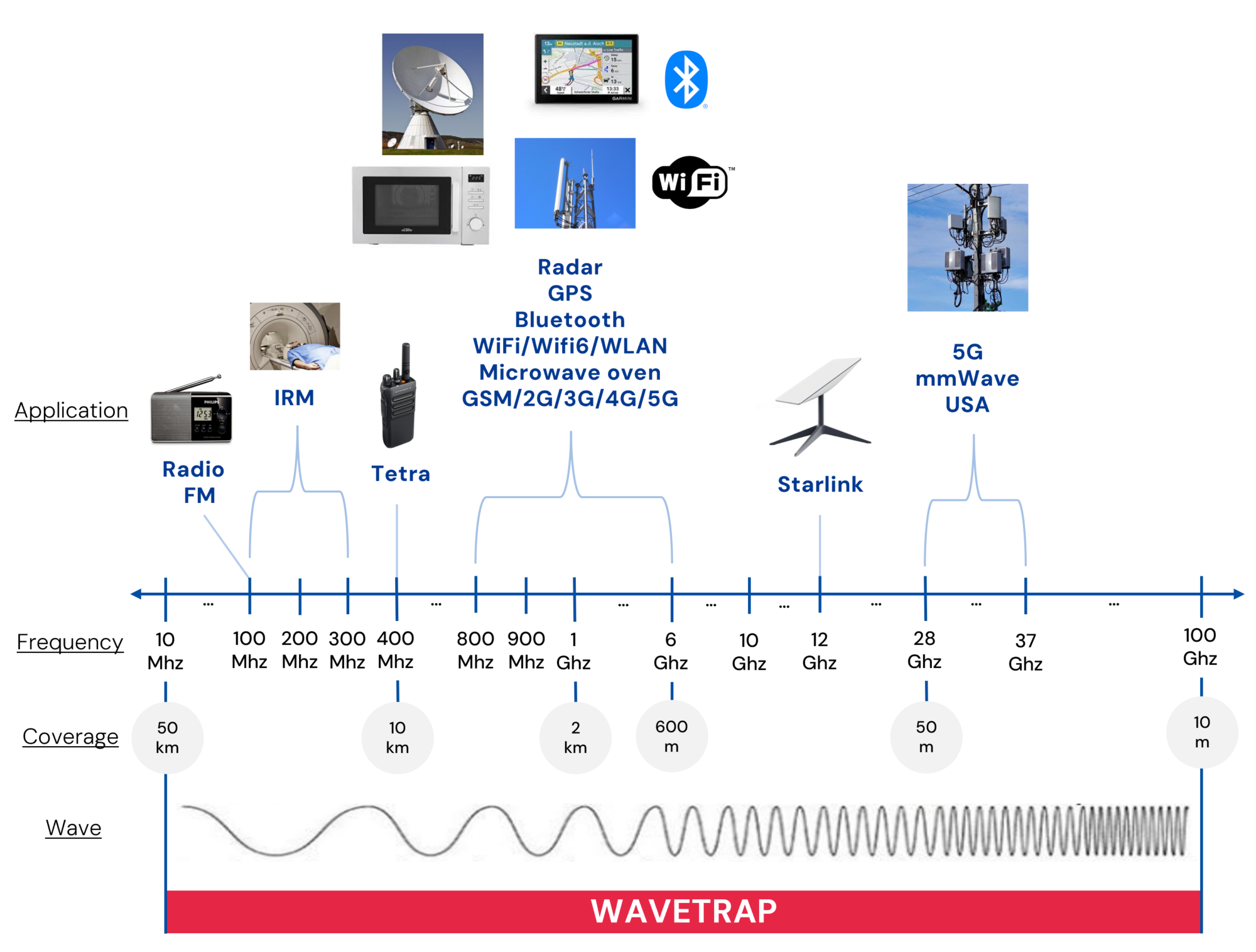
Here are three practical ranges, with common examples you’ll recognize:
1. Lower frequencies (kHz to low MHz — and nearby)
These frequencies can travel far and penetrate well, but they carry limited data compared to higher bands.
Examples include some broadcast and long-range communication systems.
2. Radio frequencies (RF: hundreds of MHz to a few GHz)
This is where most day-to-day connectivity lives—especially inside buildings.
Examples include:
- Wi-Fi / Wi-Fi 6 (2.4 GHz and 5 GHz)
- Bluetooth
- GPS (around 1.5 GHz)
- Microwave Oven (2,4 GHz)
- Professional radio systems (e.g., TETRA)
- Mobile networks (2G/3G/4G and 5G “sub-6”)
3. Higher frequencies ( mmWave: above ~10 GHz)
These frequencies can carry a lot of data, but they tend to be more “line-of-sight” and more sensitive to obstacles.
Examples include:
- 5G mmWave (commonly around 28–39 GHz in some regions)
- Satellite communications in higher bands
- Certain radar and specialized links
So when someone says “we need shielding,” the first question is always: shielding against which frequencies?
Why attenuate electromagnetic waves?
EM waves are not “good” or “bad” by default—they are tools. But in some environments, it becomes useful (or critical) to reduce them, for example:
1. To avoid interference
In hospitals, laboratories, data centers, or technical rooms, unwanted signals can disturb sensitive equipment, create measurement noise, or reduce system stability.
2. To improve security
In high-security settings, controlling EM waves can reduce unwanted connectivity and lower the risk of information leakage (proximity attack, EM Pulse, Eavesdropping). If signals freely pass through windows, the building envelope can become a weak point.
3. To manage exposure and comfort concerns
Some projects aim to limit electromagnetic exposure for comfort or precautionary reasons—especially in dense urban areas where multiple signals overlap.
This reduction is called attenuation.
Attenuation in dB: the “volume knob” for EM waves
Attenuation is typically expressed in decibels (dB)—just like sound insulation. The idea is similar:
- A higher dB value means more reduction of the wave passing through a material or system.
You don’t need to be an engineer to use dB correctly. Just remember:
- dB is a logarithmic scale, so a small increase can represent a significant performance step.
- 20–30 dB can already be meaningful in many everyday RF situations.
- 50-60 dB can mean no more Mobile, Bluetooth or Wifi signal in your environment
- 80–100 dB corresponds to very high shielding levels used for demanding environments.
So attenuation answers the second essential question: how much reduction do we need?
Frequencies + dB: the two criteria that define the right solution
When specifying an EM control solution, the decision is driven by two parameters:
- Which frequency range(s) are we targeting?
- What attenuation level (dB) is required?
This is especially important for glazing, because glass is often the most challenging part of a protected space: it must remain transparent and architectural while controlling waves.
Here is a practical comparison:
In glazing, the right EM solution is defined by two parameters: the frequency range to address and the attenuation level (in dB) required.
For example, a standard architectural insulating glass unit—even with advanced coatings such as high-performance multi-silver low-E—may provide around ~30 dB attenuation for certain radio signals in typical conditions. That’s quite helpful when you want to reduce RF penetration… but it can be a little frustrating when you’re simply trying to keep a phone conversation flowing without repeating: “Can you hear me?”
An MRI (IRM) observation window is a completely different world. MRI systems operate using RF energy (often in lower RF ranges, typically in the MHz region depending on magnet strength) and must detect extremely weak return signals to form images. MRI rooms are therefore shielded to block outside RF that would degrade image quality and to contain the MRI’s own RF emissions. As a result, required shielding levels are much higher—often around ~100 dB at the relevant frequencies, depending on the specification.
Attenuation of 60 dB
=
signal divided by 1 000 000
WAVETRAP: mastering electromagnetic performance while speaking “glass”
This is exactly where WAVETRAP comes in: bringing electromagnetic logic into architectural glazing in a way that matches real project needs.
Instead of a generic “shielding” claim, the approach starts with the two questions that matter:
- Which frequencies are relevant for the building and the use case (security, medical, technical, institutional, etc.)?
- What attenuation level (dB) is needed to manage interference, reduce risk, or improve control—without losing daylight and transparency?
Because in the end, the right solution is not one-size-fits-all. It is the right frequency coverage and the right dB performance, delivered in a glazing system designed for the built environment.